
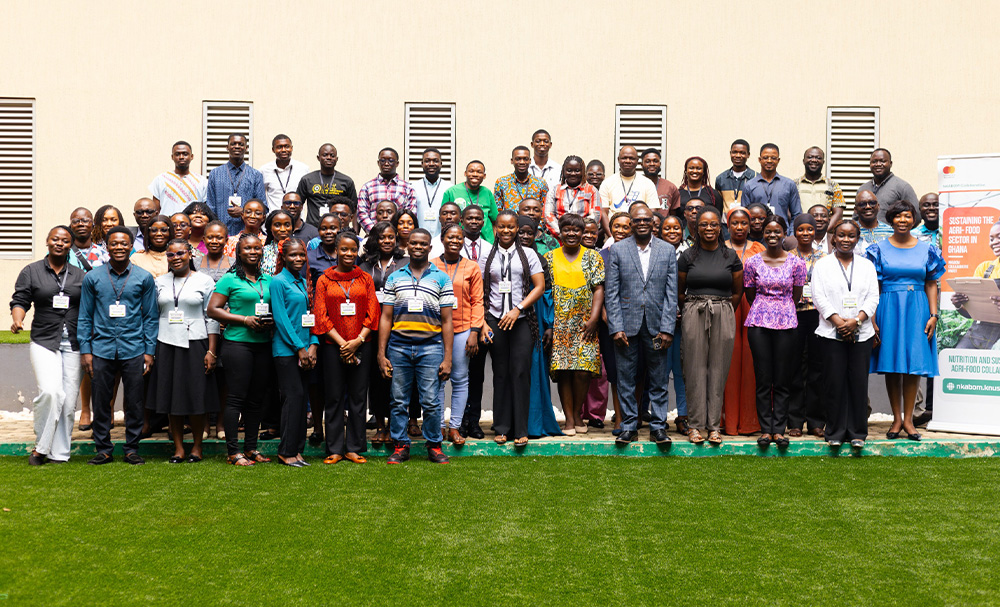
The Kwame Nkrumah University of Science and Technology, Kumasi (KNUST) Nutrition and Sustainable Agri-food Collaborative, in partnership with the Mastercard Foundation (Nkabom Collaborative), has commenced its Entrepreneurship Intervention Training (EIT) for Micro, Small and Medium Enterprises (MSMEs), with a focus on strengthening business management, promoting enterprise growth and expanding employment opportunities within the agrifood value chain.
The training brought together 51 participants to equip them with practical entrepreneurial and managerial skills to manage their businesses effectively, improve their sustainability and build enterprises capable of creating jobs.
Participants will receive training in Design Thinking, the Nkabom Hybrid Business Model Canvas (HBMC), marketing, team formation and human resource management, as well as financial management, and record-keeping.

Prof. William Otoo Ellis, Principal Investigator of the KNUST Nkabom Collaborative, urged participants to remain focused on the training and its potential impact on their businesses.
“Your presence here is not by chance. Be focused on the impact that this training will equip you with and make use of it,” he said.

Prof. Wilberforce Achiaw Owusu-Ansah, Pillar Lead for the Entrepreneurship Pillar of the Nkabom Collaborative, highlighted the importance of enterprise growth in addressing youth unemployment and expanding employment opportunities.
He referenced data from the Ghana Statistical Service, indicating that young people aged 15 to 35 made up 36.9 per cent of Ghana’s population, with youth unemployment averaging 21.9 per cent in the first three quarters of 2025, compared with the national average of 12.8 per cent.
Prof. Owusu-Ansah observed that micro, small and medium enterprises accounted for approximately 90 per cent of businesses in Ghana, 80 per cent of the workforce and 70 per cent of gross domestic product (GDP). He observed that this makes MSMEs critical to the country’s economic development and job creation efforts.
“The jobs we need will not come from a single factory or a single policy. They will come from MSMEs like yours,” he said.
Prof. Owusu-Ansah stressed that business growth requires deliberate management practices rather than chance. He identified financial discipline, customer understanding, formal record-keeping, effective business systems and the use of digital tools as essential elements for building sustainable enterprises.
He highlighted the importance of creating decent employment opportunities, noting that growing businesses must provide workers with fair remuneration, safe working environments and opportunities for learning and development.
“Our youth do not need any job. They need decent jobs: fair pay, a written contract, a safe workplace, and a chance to learn,” he stated.
Story and Photos: Michael Kwawu


